
What is B2C e-commerce (Business to Consumer)?
Home » E-commerce » What is B2C (Business to Consumer E-commerce)?

- What does B2C mean and what does a B2C sales site consist of?
- How does a business-to-consumer sales portal work?
- What advantages does a turnkey online store integrated with ERP offer?
These are some of the aspects addressed in this article. In addition to this information, the following lines also present some examples of ecommerce platforms in Romania, along with the results obtained by companies using a modern B2C sales site.
B2C online commerce. Learn more about the B2C Romania ecommerce platform from Senior Software!
What does B2C (Business to Consumer) mean?
B2C (Business to Consumer) e-commerce is a form of electronic commerce or online commerce that describes transactions carried out directly, via the Internet, between a company and the end consumer. The website where these transactions are carried out is most often called an online store or e-commerce platform. Among the distinctive elements of an online store are the virtual shopping cart or the short sales cycle, the goal being an immediate purchase by the customer.
Business to Consumer – acronym B2C
B2C online store
About B2C e-commerce
Through a B2C online store, a company can present its product or service offering to end consumers. Once they arrive on the site, they can analyze the offer and add the desired products to their virtual shopping cart. Later, to complete the order, they will have to choose a payment method and provide delivery details.

What are the advantages of a B2C e-commerce platform?
Customers are no longer limited by the company’s working hours because the online store is available 24 hours a day.
The B2C ecommerce platform can be accessed from anywhere there is an internet connection and from any type of device: desktop, laptop, tablet or phone.
The launch, promotion and maintenance costs for a B2C or B2B online store are lower compared to a physical store, and the coverage area is much larger: with a single online store, customers from any desired city, country or geographic area can be addressed.
An online sales platform does not necessarily imply the existence of stock: some companies choose to order products from suppliers/manufacturers exactly when they are required, which means they will have minimal inventory expenses.
The ways in which the product offer can be presented in the online commerce platform are extremely diverse: attaching an unlimited number of images or videos, dedicated pages for the newest offers or the most purchased items, complete descriptions for each individual product, etc.
Customers’ access to the desired products is quick, because an online store has various functionalities, such as: dynamic search filters, wishlist – lists of desired products, the possibility of making comparisons between products, etc.
Registration in the online store can be done depending on each customer’s preferences: by creating an account with detailed information, through a visitor account (if they do not want to provide personal data) or through a social network account (such as Facebook).
E-commerce or electronic commerce platforms offer secure and varied payment methods: online via credit/debit cards, cash or card on delivery, by money order or bank transfer.
The concept of a virtual shopping cart allows the visitor to add products as they browse the site, and at the end of the visit to order all or just some of them. This ensures that the products are reserved for the entire duration of the visit to the site. Moreover, if they have not completed the order on the spot, they can come back after a while and resume it, depending on the availability of stock at that time.
Promotion methods are extremely diverse, starting with newsletters, online banners, social networks, Google Adwords, voucher campaigns, promotions, price discounts, etc.
Promotion costs are easier to measure and control, and can be adjusted permanently, quickly and easily in an online sales platform, depending on the results obtained.
Learn more about the B2C online sales platform
SeniorB2C – a B2C sales ecommerce platform, accessible from any digital device and easily customizable.
B2C definition
Business to Consumer meaning
B2C sales

What does B2C sales mean?
Business to Consumer e-commerce is defined as the activity of buying and selling goods and services over the internet. Thus, in B2C e-commerce, companies sell their products and/or services directly to end customers. B2C e-commerce customers can make purchases from any device with internet access, and B2C transactions are carried out digitally, which simplifies the buying process.
Therefore, the goal of Business to Consumer e-commerce companies is to allow customers to purchase anything they want, anytime, from anywhere, using any type of digital device.
E-commerce platform – online sales
Through an online store, both consumer goods and services, such as telephone subscriptions or travel packages, can be sold.
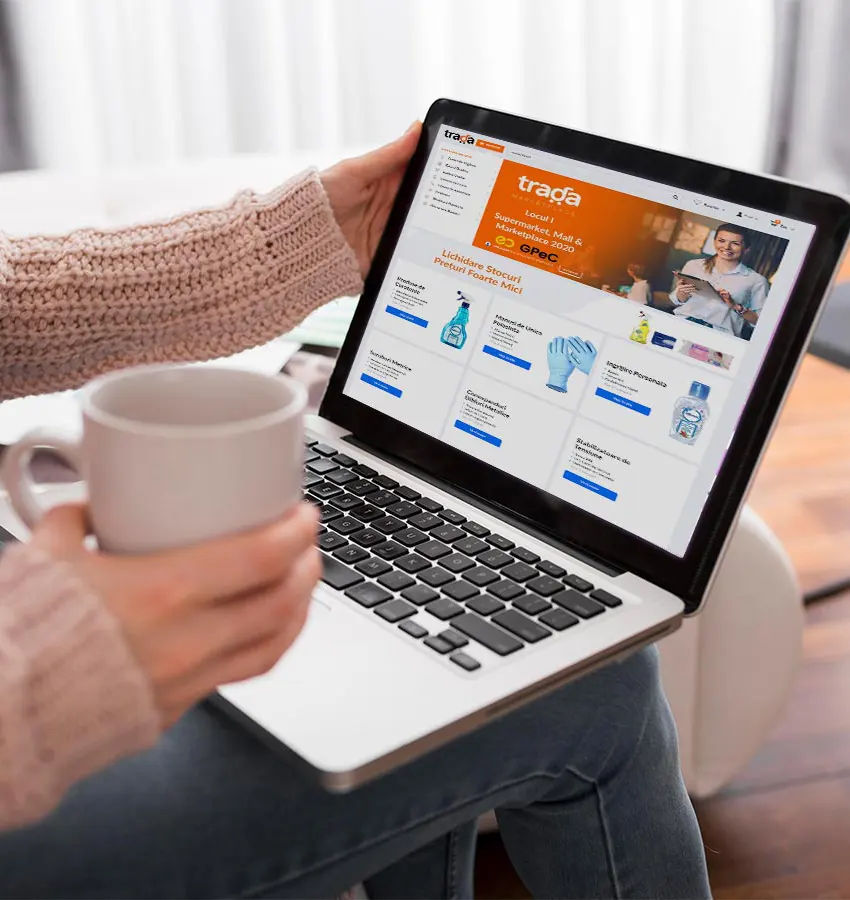
Moreover, in addition to the usual online stores, there are other types of e-commerce platforms for B2C online sales (Business to Consumer e-commerce), such as: marketplace platforms – sites that bring sellers and buyers together (Trada.ro), portals that offer services and content in an integrated manner, sites specialized in providing content (video, music, news) or specialized in certain services.
B2C marketing
Business-to-consumer marketing, or B2C marketing, refers to the techniques and strategies used by a company to promote and sell its products or services to the end customer. Unlike B2B customers, B2C customers’ purchasing decisions are predominantly emotional, with consumers generally seeking goods and services based on an immediate need and making purchases more quickly.
Thus, a successful B2C marketing strategy for e-commerce usually triggers emotional reactions or responses, by highlighting the benefits or advantages that can be obtained by the end consumer from using the chosen product or service.
B2C e-commerce integrated with ERP
Online commerce platform integrated with ERP (Enterprise Resource Planning) system
Integrating the B2C e-commerce platform with an ERP system involves the automatic transfer of information between them, which means that:
- All orders placed through the online store arrive directly in the ERP
- Prices set in the ERP are also available in the online commerce platform
- Product stocks can be viewed by customers directly from the online store
- Information about customers, provided by them when registering in the online store platform, is automatically transferred to the system at the headquarters
E-commerce ERP for online sales platforms
What advantages does integrating the online store with the ERP system offer?
- Customer orders from the online sales platform arrive directly in the ERP software system, and subsequent documents are automatically generated based on them, such as: notices, invoices, etc. Thus, orders are processed much faster and reach customers in a shorter time.
- Many of the operational processes are automated, and the personnel requirements and related costs will be lower, as will the possibility of errors.
- The accuracy of the information is higher, considering that both prices and stocks in the online sales platform are updated in real time and synchronized with those in the ERP.

Example of B2C Romania
Romania ecommerce platform – B2C online sales store
Senior Software provides companies with a B2C e-commerce sales platform, accessible from any digital device and easily customizable.
The Senior Software Romania ecommerce platform for B2C online stores helps simplify company processes and provides the necessary tools to achieve the desired sales performance.
The advantages that Senior Software’s B2C ecommerce platform offers are: modern design, efficient promotion and detailed exposure of the entire product portfolio, as well as easy navigation that ensures pleasant shopping experiences for customers.