

What is ERP (Enterprise Resource Planning), how does it work and what benefits does it bring, how ERP solutions fit the Romanian business environment – these are the aspects addressed in this article. The explanations and definitions regarding ERP systems are complemented with examples and successful implementations in Romania, criteria for selecting an ERP software, case studies.
ERP System Romania. Find out more details about software solutions!

What means Enterprise Resourse Planning
Acronym
Definition
An ERP software is a system used by companies to manage resources. The software system allows for the integrated management of processes and operations in different business areas: purchasing, sales, accounting, production, customer relationship management, project management and other activities related to the supply chain.
History of ERP
The beginnings of ERP systems
The name was given in 1990 by technology analysts for the software system that deals with business management, namely ERP – Enterprise Resource Planning. However, the history dates back to 1913, when Ford engineer Whitman Harris created the EOQ – Economic Order Quantity model. For about 50 years, this paper-based manufacturing system represented a benchmark for production planning activity.

The evolution of ERP software systems
The evolution of technology since then has led to the emergence of similar systems that cover other business activities (customer relationship management, human resource information, financial integration), leading to a new type of business management software: ERP system.
Thus, departments like marketing and sales, inventory, production, finance – accounting, human resources, could be integrated into the system through interdependent modules.
Modern management software system
Thus, ERP systems have now come to encompass different industries and types of activities, making it possible to easily integrate departments, regardless of the areas they cover. The global ERP systems market was valued at $39.65 billion in 2019, and is expected to reach $65.2 billion by 2025.
What is an ERP system
To find out what an ERP system is, we must first consider the fact that in an organization, information is most often dispersed. Thus, an ERP is the tool that supports the transposition of all information into a single, integrated software. It is based on a single IT platform within which the management, automation, monitoring and control of these processes and activities take place. The implementation of Enterprise Resource Planning solutions is possible in any company. These software systems can be applied to different types of activities: production, distribution, services, construction, retail or e-commerce.
What does ERP software do?
The software deals with the organization of business processes and activities, provides centralized access to company data and establishes a tight connection between key information, users, departments and other software systems. The software allows the automation of a wide range of operations that determine the efficiency of workflows.
When we talk about such a software system, data is the main unit of measurement, and the database is the central repository where they are stored and organized. The connection between the database and the functionalities that the system performs is achieved through the application. This is responsible for the activities of collecting, validating, processing, transferring or exporting data, operations that it performs through the interface.
How does the data get into the application?
The ERP application can collect data through different methods:
- Input by operators: from the keyboard or directly – by scanning barcodes, for example
- Import from other databases or systems
- Transfer using EDI (Electronic Data Interchange) technology

ERP meaning
Enterprise Resource Planning, also known as ERP system, is a software that integrates al processes and information needed to run a business. The system helps companies to efficiently manage all aspects of their business, such as finance, inventory, HR, manufacturing, supply chain, services and so on.
ERP systems provide centralized access to company data, and establish a connection between key business information, users, departments, and other software systems. It automates a wide range of operations allowing companies to work more efficiently and be more productive.
When referring to the meaning of ERP systems, data represents the main unit of measurement, which is stored and organized in a central database. The connection between the database and the functionalities of the system is made through the ERP application. The software is responsible for collecting, validating, processing, transferring, and exporting data, operations that are performed through its interface.
Soft ERP functionalities

- It achieves integrated management of business components through access to a common database
- Automates and standardizes operational processes, reducing repetitive manual tasks
- ERP software optimizes the definition of workflows and allows monitoring of activities and resources
- Allows restrictions and alerts based on criteria entered into the system by the user
- Generates multiple financial and accounting documents (invoices, statements, accounting notes, etc.) and successfully replaces accounting programs
- Collects, stores, processes and centralizes useful data
- Plan company resources, organize and track business processes
- Provide access to any business information, in a secure way
- The ERP software platform makes it possible to define access levels based on internally established roles
- Manage financial operations within the organization
- Contributes to simplifying the processes of establishing and tracking income and expense budgets
- Manages maintenance, sales, supply operations, etc.
- Generates reports for company departments or different business components

Learn more about ERP software applications
SeniorERP – state-of-the-art software with over 500 successful implementations and a wide range of integrated functionalities that successfully cover all business components, regardless of the company’s field of activity.
Benefits for companies with ERP
- Increases work speed and increases visibility on company processes
- Improves workforce productivity and reduces costs
- Ensures traceability in daily operations
- Improves the accuracy of the data the organization works with
- Reduces the time dedicated to data processing activities
- Reduces order processing times and their delivery
- Enables much better interdepartmental collaboration
- Considerably reduces economic risks
- Automates repetitive manual tasks and reduces human errors
- Ensures increased transparency over key information (products, stocks, prices, suppliers, etc.)
- Improves communication and relationships with customers / partners / suppliers
- Improves cash flow and ensures increased control over the entire business

ERP selection criteria
The process of selecting such a system is crucial for the success of the implementation project. Whether they are purchasing an ERP software system for the first time or want to change their current system, companies must consider a series of criteria, including:
- The ability to adapt the solution to the specifics of the client’s activity. A solution suitable for the field in which the company operates will have integrated, in addition to general business management functionalities, a series of best practices and know-how, acquired following implementation at other companies with similar activities.
- Adapting the software to the legislative context of the country the client operates in. In addition, the ability to quickly adapt to any legislative changes, without causing interruptions in the client’s activity, is also extremely important.
- Scalability, or the ability of the software system to grow with the business it manages.
- The quality of the support service offered by the provider, extremely necessary in various situations that may arise related to the operation of the system, making customizations, upgrades of the solution and more.
- Data security, backup and information security services, as well as role-based access to software application data.
- Advanced reporting and analysis capabilities, which can be included in the system or obtained by integrating ERP with Business Intelligence solutions. This will significantly contribute to improving decision-making processes within the company.
- The possibility of easy integration / extension of the software with other solutions, such as e-commerce platforms, solutions for sales automation, production management and planning or warehouse optimization.
Find out how to choose the best ERP in Romania for your company >>
Accounting software
What is the difference between an ERP program and an accounting program?
ERP software systems are often confused with accounting software, many considering them to be one and the same. However, even though they sometimes have similar functionalities, the difference is major. Thus, if an accounting program is limited to the financial-accounting area of the business, an ERP software covers all components of the business, offering specific benefits to each department.
An accounting program manages receivables, payables, the inventory value of fixed assets, as well as the financial-accounting reporting area. An ERP system includes, in addition to those listed above, functionalities related to inventory management, supply chain management, sales through various channels, customer relationship management, project management, production management and more. In this way, the application covers not only one function of the company, but all of them, bringing them together in a single system, to provide visibility and control over the entire business.
ERP vs CRM
What is CRM
CRM is the acronym for the English name of the Customer Relationship Management solution. A CRM software system manages all the ways in which customers interact with a business. CRM functionalities initially targeted sales departments, but as they were developed, such solutions became capable of managing other components of a business (customer relations, marketing, service, etc.).
The difference between ERP and CRM solutions
The fundamental difference is that ERP systems are generally designed to manage financial data and finance and accounting departments, while CRM systems are designed to manage customer data used by sales and customer service departments. CRM solutions generally aim to increase profits by increasing sales, centralizing data from the following areas: marketing, sales, contact management and customer support.
On the other hand, an ERP software solution aims to plan and manage resources more efficiently to reduce expenses and provide increased control over costs and business processes. When we talk about ERP systems or solutions, they are mainly used by human resources, finance & accounting, production, purchasing, and delivery departments.
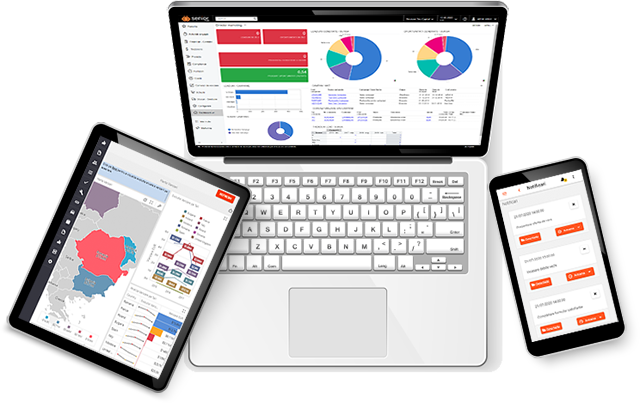
Examples of software systems
Let’s take SeniorERP and SeniorXRP for example – two ERP systems offered by Senior Software. Both solutions present specific functionalities of an ERP system, indispensable for the types of companies they address. The two examples of information systems – SeniorERP and SeniorXRP – although they have a wide range of similarities, present capabilities that differentiate them precisely in order to respond efficiently and accurately to the type of business they address. These are essential because companies, in turn, differ depending on size, industry, length of workflows, etc.
-
SENIORERP
SeniorERP – for businesses with relatively standard workflows, which aim to integrate and optimally manage the activities performed.
SeniorERP is a 100% Romanian system, with flexible licensing, which allows for quick implementation and provides immediate results. The system incorporates know-how from over 500 implementations, and the new version has been optimized to support remote work. With a unitary structure and an intuitive interface, SeniorERP is a user-friendly software, which easily adapts to the business needs of the local business environment.-
SENIORXRP